
The Threat to the Badlands
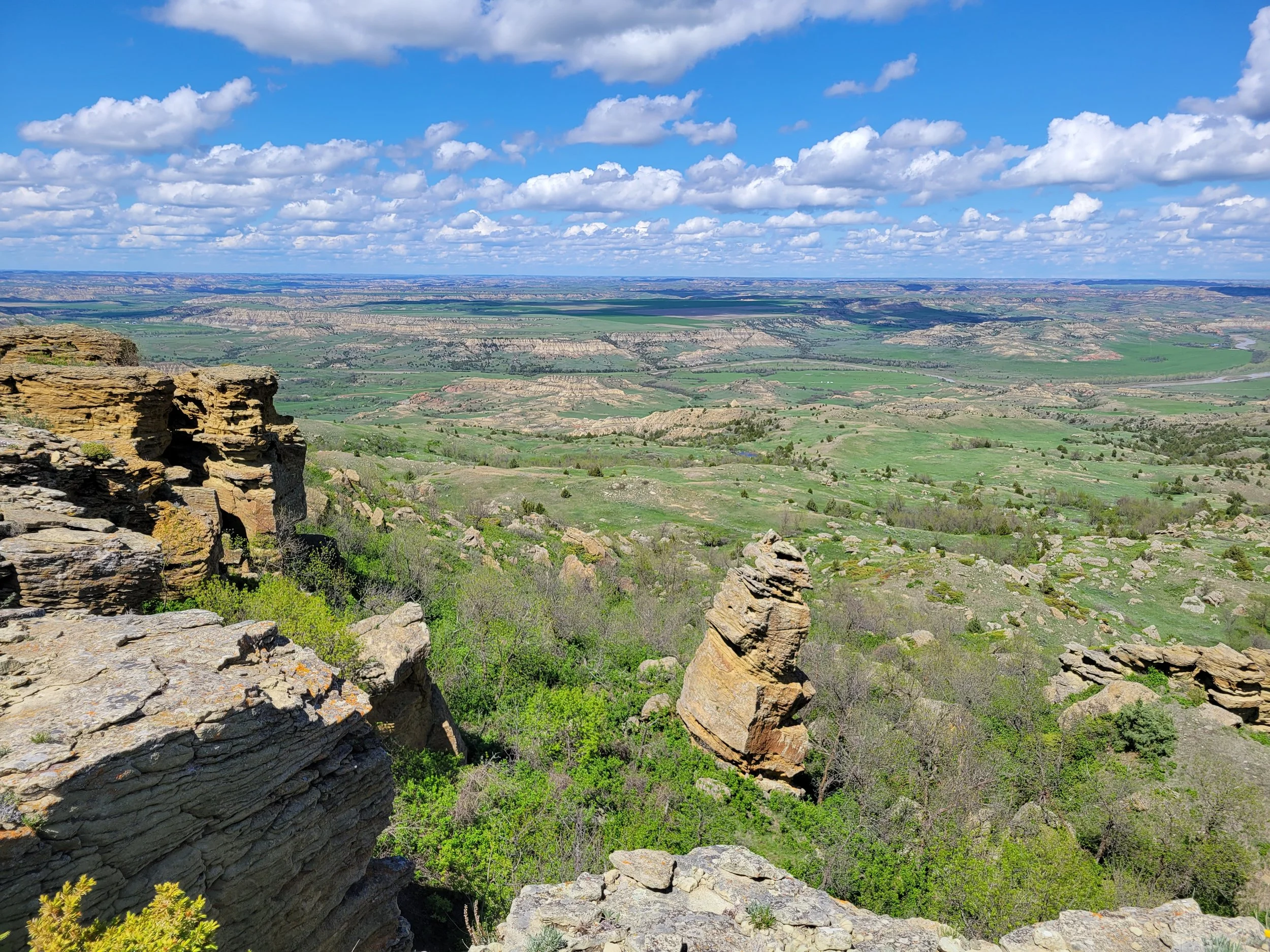
It was the practice of our friend, and Senior Advisor to the Badlands Conservation Alliance, Valerie Naylor, when she was Superintendent of Theodore Roosevelt National Park to create an annual list of threats to the park she supervised. Now, at a time when there are unprecedented pressures on the North Dakota Badlands, from directions we could not have foreseen, we of the Badlands Conservation Alliance want to call your attention to our deepest concerns. What follows are brief descriptions of both perils and possibilities. We can provide more detailed information upon request.
The Extraordinary Places Initiative
The Extraordinary Places Initiative was proposed in 2014 by the North Dakota Attorney General’s Office and would have required special development protocols in the vicinity of the Little Missouri River and at a number of extraordinary places in the Badlands, including the area around Bullion Butte, perhaps the most iconic of hundreds of buttes in North Dakota. We believe that this initiative should be renewed so that North Dakota will not lose the natural places that make it great. The Extraordinary Places proposal would not have prevented the extraction of a single barrel of oil from the Badlands. It would only have ensured that government bureaucrats, the oil industry, and other representatives of extraction would be required to take special precautions to protect the lands we grant them temporary license to exploit. The closer to the Little Missouri River and the closer to Theodore Roosevelt National Park the more development restraint would be required.
New Oil Development in the Badlands
We believe that there should be special development regulations on North Dakota’s public lands, especially the Little Missouri National Grasslands, where we would urge extraordinary caution in developing oil and other resources. We understand that the United States Forest Service (USFS) is committed by law and protocol to multiple uses, including mineral development. Oil installations of any sort should not be visible from the Little Missouri River, and every effort should be made to blend oil installations throughout the Little Missouri River Valley into the pastel colors of the Badlands. New approach roads should be kept to a minimum and should be routed carefully to blend with the land as much as possible.
Roadless Areas
The few existing roadless areas in the Badlands are cherished by many, including ranchers, birders, hunters, hikers, campers, photographers, and more, and should remain roadless. There is now very little land in the Badlands that is not impacted by roads. No further developments should be permitted on the USFS roadless areas. We support the designation as Wilderness for those areas in the Little Missouri National Grassland that are currently deemed Suitable for Wilderness. It is not quite too late to save what little is left. We oppose any further infrastructural development in the remaining fragment of roadless areas.
Medora Area Development
We support the creation of a Theodore Roosevelt Presidential Library in Medora, but we have concerns about economic developments that could compromise the character of Medora and its immediate surroundings. One of the principal attractions of Medora is its charm and historic character, principles insisted upon by the re-creator of Medora Harold Schafer (1912-2001). It is not (yet?) West Yellowstone, Montana or Keystone, South Dakota. We believe that efforts should be made to ensure that any further development is tasteful, understated, and historically grounded. We are concerned about new housing developments south and west of the town, the impact on the water and sewage infrastructures, aesthetic blight, the amenities demands of privileged visitors, and commercial entertainments that damage the area’s unique character. We support city and county zoning ordinances that preserve the historic character of the area that Theodore Roosevelt first visited in 1883. The Presidential Library is going to introduce the Badlands to hundreds of thousands of new visitors, many of whom will want to buy up and lock up some of the most beautiful parcels of the area. We want new visitors to become the Badlands’ protectors and friends.
Crossings Over The Little Missouri River
We cherish the Elkhorn Ranch Unit of Theodore Roosevelt National Park and the surrounding public lands. It is important to remember that the national park property (218 acres) is only a fraction of Roosevelt’s 1884-1890 ranch, which extended four miles north and four miles south of his headquarters, and all the way to the east and west edges of the Badlands. We urge caution in the discussion of new bridges that would impact the national park. We do not believe that a new bridge is necessary north of I-94, but if a new one is built it should be well away from the Elkhorn Ranch Site, a place of enormous solemnity and beauty, and a national shrine to conservation. Our concerns are dust, noise, and visual scarring of the Badlands at or near Roosevelt’s primary North Dakota ranch site. Several years ago, a bridge was built illegally over the Little Missouri State Scenic River east of the North Unit of Theodore Roosevelt National Park. The west end of the bridge and the road leading to it are on public land managed by the U.S. Bureau of Land Management, connecting it to a private ranch. After media reports about the bridge and associated nearby development (construction of a water depot and illegal plowing of native prairie on public land for a hayfield), the ranch owner who built the bridge was required to reclaim the public land and was fined and required to post a $100,000 bond to cover possible future damages or bridge removal costs (so that he can’t just walk away and leave a bridge damaged by a spring flood). We are also concerned about future low-water crossings on the Little Missouri. The two that exist now impede canoeists and degrade the aesthetic qualities of one of America’s most scenic rivers. There is no data to support additional bridges or low-water crossings, and in the absence of such data, we would oppose new construction of either of them. We also believe there should be no use of eminent domain or other “taking” of private property to build a bridge.
Water from the River
It is one of the most beautiful and enchanting rivers in America, partly because it is so improbable. We oppose any diversion of water from the Little Missouri River or the aquifers beneath it for industrial use. We believe water for oil development should come from other sources, particularly Lake Sakakawea, and that the Little Missouri River should be off-limits to water diversion at any point upstream of Lost Bridge north of Killdeer.
Airplane and Helicopter Access
At a time in which quiet spaces are increasingly limited or endangered, we hold dear the peacefulness of the wild places in the Badlands and testify to their restorative value as well as their importance to wildlife. We see no reason why such invasive infrastructure as an airport should be created to serve the most privileged visitors. We believe you should have to earn the Badlands rather than be dropped into them. There are airports nearby in Dickinson, Bowman, Watford City, Williston, and Glendive. Any airstrips or helipads that might now be constructed must be put in a reasonable place, outside the Badlands proper, in a location that minimizes impact on our public lands, especially the units of Theodore Roosevelt National Park. This includes noise pollution, an unfortunate fact of life over the Grand Canyon, a bad commercial development that damages the solemnity and the sublimity of the canyon.
Light Pollution
We value the night sky above the Badlands and are concerned with measurably increased light pollution in the past thirty years. North Dakota has over 20K oil and gas wells, and the number is predicted to double in the next decade. Flaring will thus continue to alter the dark sky experience in the Badlands that also disrupts the wildlife we revere. We encourage bold steps be taken to adopt Dark Skies Initiatives.
Fences across the Little Missouri
There has been a proliferation of new barbed wire and single-strand electric fences across the Little Missouri River in recent years because, as one rancher put it, “Neighbors just don’t get along like they used to.” There’s no specific law against a rancher fencing his or her property, even when that means crossing the river. Back in the 1990s the Little Missouri Scenic River Commission (LMSRC) promulgated a “policy” which says fences are okay as long as they have a gate which can be opened to let recreationists through. We know from hard experience that those existing cross-river fences have no gates or even warning flags to prevent canoeists from being injured. The LMSRC policy has no teeth, because the ND Attorney General has ruled that the LMSRC operates in an “advisory” capacity only. The designation Little Missouri State Scenic River lulls plenty of people into believing the commission works to protect the river basin. In fact, to the extent that it has any voice at all, the commission usually rubber stamps development. There are lots of fences across the river and always when you least expect them. There doesn’t seem to be a solution to this problem, since legislation requiring that would likely never get passed in North Dakota. The only solution seems to be neighbors getting along better and showing greater hospitality to innocent recreationists who are floating the public lands they own.
Ridgeline Developments
We urge the Badlands counties—Slope, Golden Valley, Billings, Dunn, and McKenzie—to enact thoughtful zoning laws to prevent or discourage the construction of homes, hostelries, or other installations on Badlands ridges. These structures may feed pride (and enable spectacular views to their owners) but they pollute the viewshed shared by everyone who is not a private landowner.
The Davis Oil Refinery
The much-delayed Davis Oil Refinery is still planned for construction just west of Belfield, only three miles from the boundary of Theodore Roosevelt National Park and at the park’s gateway from U.S. Interstate 94. We must remain vigilant. We at the Badlands Conservation Alliance do not oppose an oil refinery in western North Dakota, but it should not in any way be permitted to impact the visitor’s experience at Theodore Roosevelt National Park or the southern Badlands. Imagine an oil refinery at the portal of Glacier National Park, or Yellowstone, or Yosemite, or the Grand Canyon. Any refinery or other industrial installation should be sited well away from I-94, invisible from the interstate highway or the park, and noise from such a refinery should not be heard from anywhere in the park. The fact that we have to call your attention to such proposals—an absurdity by any reasonable measure—is a sign of the underdeveloped conservation ethos in North Dakota. The Badlands Conservation Alliance exists to raise public awareness to the splendor and fragility of the Little Missouri Valley.
Paving the West
We oppose the creation of new roads in the Badlands. In fact, some no longer needed oil service roads should be obliterated and the land reclaimed. With the coming of more and more people to western North Dakota, particularly with the completion of the Theodore Roosevelt Presidential Library, there will be pressure for more of the amenities available in other scenic places in the American West. We oppose the paving of East River Road, West River Road, ND 16 from Marmarth to Golva, and other scenic gravel and scoria roads in the Badlands.
Native Americans at the Table
Native Americans also have a historical presence in the North Dakota Badlands. The Little Missouri River Valley was part of Mandan, Hidatsa, and Lakota homelands before those nations were dispossessed of the great majority of their territory in the second half of the nineteenth century. There are a number of important spiritual sites in the Badlands. Sitting Bull used to winter sometimes on the upper Little Missouri. We believe future development in the Badlands, public or private, should keep this in mind, and consult Native American scholars and elders to make sure these sites are recognized, respected, and protected.
Building a Badlands Coalition
The Badlands Conservation Alliance is dedicated to creating honest, thoughtful, and nonpartisan dialogue as new pressures come to the North Dakota Badlands. We believe all stakeholders should be at the table for every serious decision that impacts public enjoyment of this unique place. We believe, above all, that heritage ranchers, whose ties to the land we recognize and respect, and Native Americans, whose ties to the land predate that of the ranchers, must always be at the table. The confiscation of the Badlands from the sovereign domain of the Mandan, Arikara, Hidatsa and the Lakota tribes by the provisions of the Fort Laramie Treaty of 1851 and its progeny can never be downplayed, overlooked or forgotten. We believe the accumulated suspicions and mutual frustrations that have developed in the last decades in southwestern North Dakota can be eased (even healed) if all the interested parties agree to talk the issues with mutual respect and generosity of spirit. We are eager to work with any individuals or entities that have an interest in the sanctity and the future of the Little Missouri River Valley.