
A Spiritual Essay
A note from BCA President Bill Knudson.
The North Dakota Badlands have significant scientific and ecological interests as well as paleo and cultural treasures. The oldest known cottonwood tree in the world is located in the North Unit of Theodore Roosevelt National Park. We value the night sky above the Badlands and are concerned with measurably increased light pollution in the past thirty years. We commend the staff of Theodore Roosevelt National Park for their Dark Skies Initiative and programming, which has been in place for many years. Much more about our knowledge of the Cretaceous-Paleogene (K-Pg) Impact Boundary and other paleo resources can be found at the North Dakota Heritage Center (including the website of the State Historical Society of North Dakota).
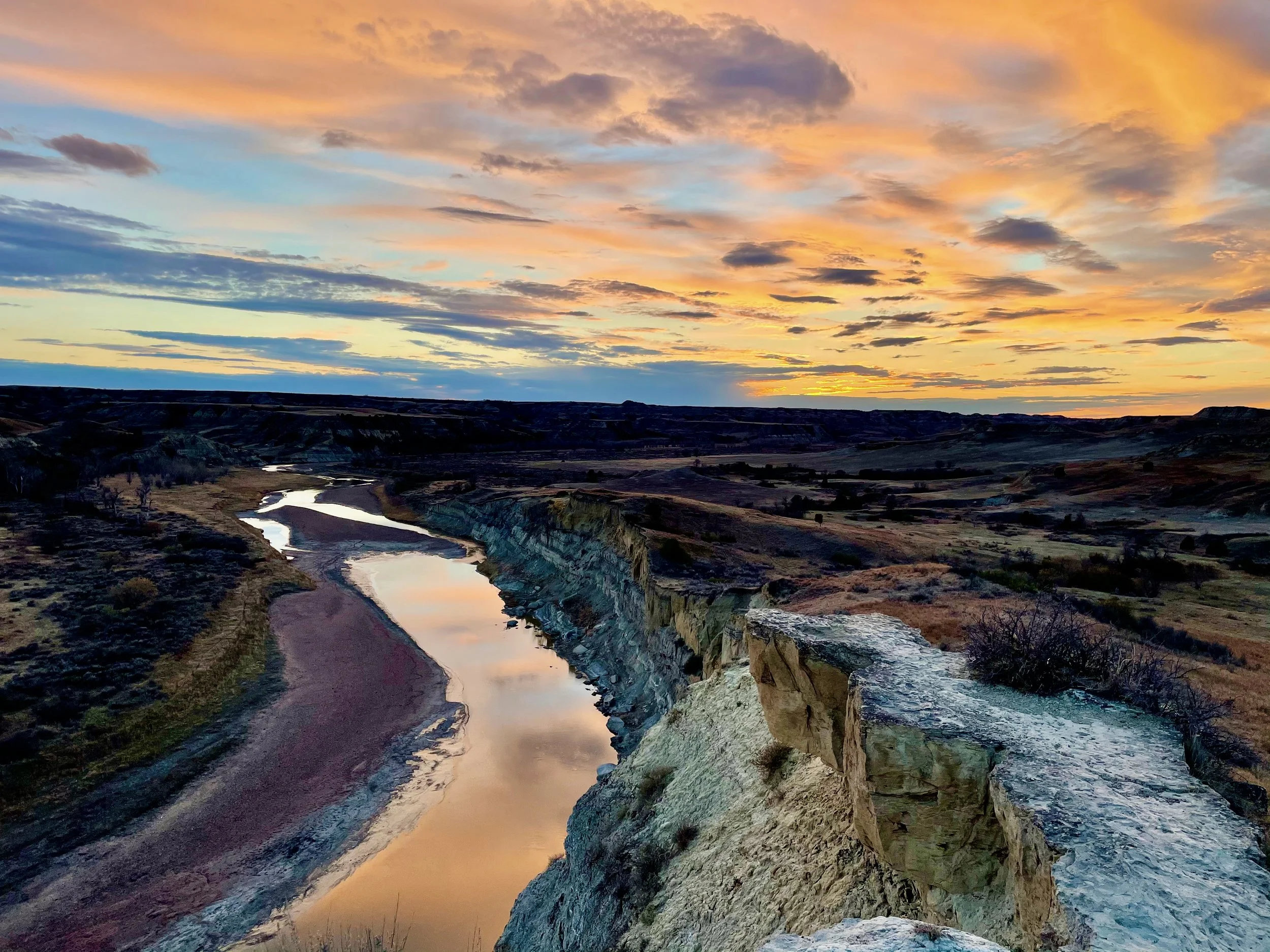
For us, the Badlands of North Dakota are a spiritual place. Essentially, spirituality is a knowing, a feeling, a sense of something beyond and greater than one’s self that cannot be defined or explained—it is a mystery. A sacred mystery, based in the reality that there is something much larger and greater that calls and requires seeking. Places of solitude and beauty are necessary to the process. Retreats are necessary to recreate. Recreation leaves us in a more knowing place, and over time promotes growth and an inner peace. This was known ages before the modern settlement of North America and is a worldwide phenomenon, spanning all cultures. Richard Louv, the author, says that we, especially children, have “nature-deficit disorder.” Not being connected to nature periodically has negative effects. Louv suggests that it can negatively impact physical, mental, and emotional health. Spiritual health should be added. The late Pope Francis described our earth as our Sister, Mother Earth (Canticle of St. Francis), based on the man who was his namesake, Saint Francis of Assisi. His opening lines from the Laudato Si: On Care of Our Common Home quote Saint Francis, from Section 2 of Laudato Si’ Mi’ Signore:
“This sister now cries out to us because of the harm we have inflicted on her by our irresponsible use and abuse of the goods with which God has endowed her. We have come to see ourselves asher lords and masters, entitled to plunder her at will. The violence present in our hearts, wounded by sin, is also reflected in the symptoms of sickness evident in the soil, in the water, in the air and in all forms of life. This is why the earth herself, burdened and laid waste, is among the most abandoned and maltreated of our poor; she “groans in travail” (Romans 8:22). We have forgotten that we ourselves are the dust of the earth (cf. Genesis 2:7); our very bodies are made up of her elements, we breathe her air and we receive life and refreshment from her waters.”
The encyclical goes on to quote his predecessors in statements made in their Encyclicals, Statements or Writings: Pope John XXIII, Pope Paul VI, Pope John Paul II and Pope Benedict XVI. In 1971 Pope Paul VI referred to the ecological concern as a “tragic consequence” of unchecked human activity: “Due to an ill-considered exploitation of nature, humanity runs the risk of destroying it and becoming in turn a victim of the degradation.”
These scholars and spiritual leaders are sounding an alarm. Our society is sleeping. These are not the first to ring the bell as we have commercialized large tracts of America’s wilderness, robbing our society of necessary healing places. Noted author Wayne Dyer said, “We are spiritual beings having a human experience.” He is saying our life on earth is limited. We have a reason for being here and eventually we leave this place, but our spirit is eternal. Time on this planet is an experience but not our essence. Nature is our home, our life force during our visit here and sustains us physically and spiritually. These wilderness places—places like the North Dakota Badlands—have been sacred and sought out for spiritual reasons by peoples inhabiting this part of the planet for 10,000 to 12,000 years. Protecting these places, being stewards of the few remaining wilderness areas so that our grandchildren and their children can retreat to a place largely unchanged except for the natural workings of wind, water, and time, should be a national priority. Ah, that they can see these Badlands as our parents and grandparents once saw them.
Theodore Roosevelt knew this, as did so many people with sufficient vision to understand the importance of solitude:
Being in awe with our Creator’s work.
Offering respect and gratitude for all the earth gives without taking too much.
Showing restraint against the idea that bigger is better, and that there is always a need for more.
Avoiding greed (avarice) and gluttony, two of the Seven Deadly Sins driving the human spirit instead of saving and preserving in love and caring for our fellow travelers.
If we do those things, 500 years from now, those who follow can savor in gratitude that small portions were protected, and will be thankful that those who preceded them had foresight that left these places to be treasured and perpetually passed forward.
Theodore Roosevelt came to the Badlands the second time after losing his wife and mother on the same day. He was broken. The lands along the Little Missouri River provided him the “arena” to heal, to become a leader. The land he walked continues to provide people with a place to experience emotion and physical challenge. He created similar sanctuaries throughout the United States—a legacy that continues to feed us. There is a need to build on this legacy—more shrines to counteract the bustle, noise, and stress created by life in the 21st Century. At the very least we need to slow, and then stop, the loss of wilderness. The task ahead of us requires perseverance, diligence, and much hard work.