
Why the Badlands Matter and Why We Must Protect Them
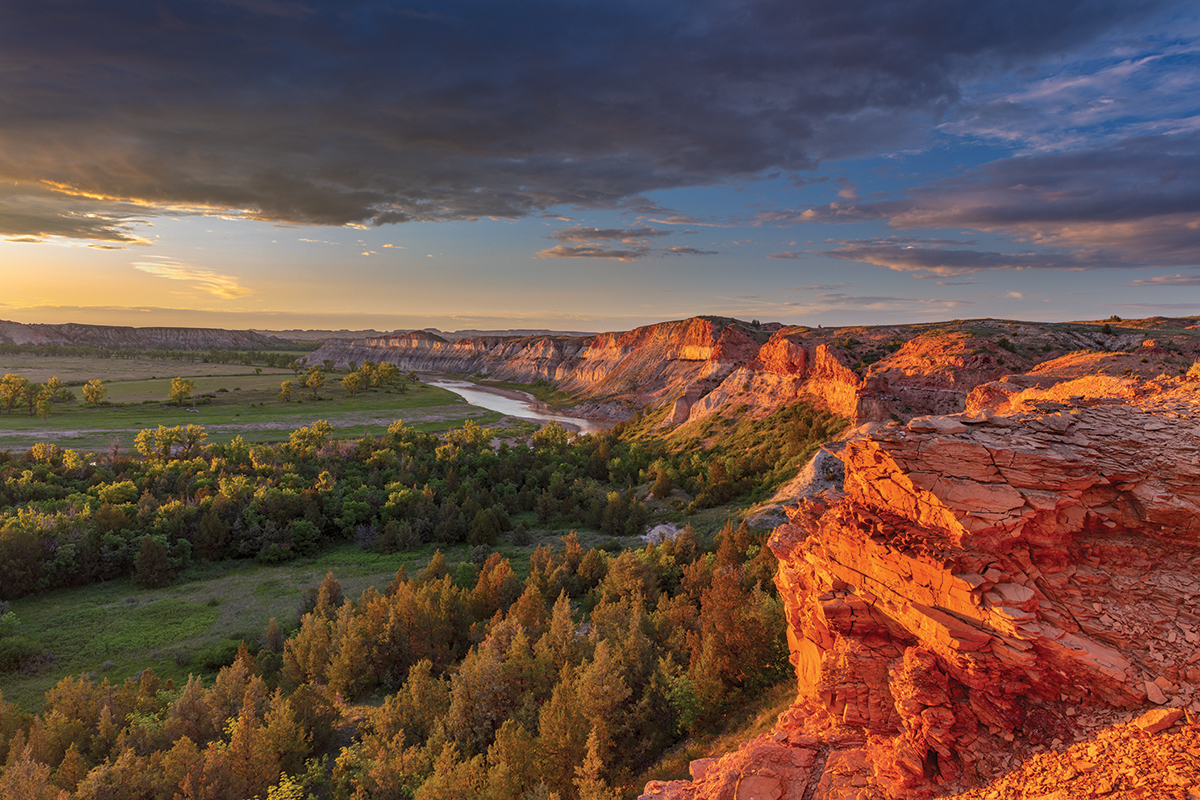
“It was here that the romance of my life began,” said Theodore Roosevelt on a whistle stop in Medora, North Dakota, on the evening of September 3, 1901. We of the Badlands Conservation Alliance (BCA) get it. We feel that romance too, and we are determined to protect the Badlands from industrial degradation and gross economic extraction.
Every great landscape in the public domain of the United States needs a vigilant advocacy group. We are that entity for the North Dakota Badlands. Our ethos is civility and constructive engagement, not environmental absolutism.
In the autumn of 1883, when he was just 24 years old, kid Roosevelt—still not fully formed—wanted a taste of the last of the American Frontier before it was too late. The Northern Pacific Railroad delivered him to the heart of the Badlands in September 1883 when white occupation and settlement were just getting underway, trailing thousands of Texas longhorns. Roosevelt came to kill a buffalo—and did so after a long frustrating hunt that would have defeated a lesser man—but while he was out playing wilderness hunter in designer buckskins, Roosevelt fell in love with the Badlands: a stark and broken landscape with layer cake striations, including lignite coal veins, pyramidical buttes, clays baked into red ceramic outcrops by burning coal veins, a jumble of sometimes magical, sometimes eerie ridgelines, bluffs, coulees, sandstone outcroppings, hoodoos, bentonite hill caps, and lush benchland bottoms of grass. Best of all (a serious distinction from America’s other Badlands), a river runs through it, winding its way along all of this starkness by way of leisurely s-curves and an ever deepening cut: the Little Missouri, North Dakota’s only official “State Scenic River,” running north from Devils Tower (soon to be President Roosevelt’s first National Monument) through bits of Wyoming, Montana, and South Dakota before it begins to carve true Badlands somewhere north of Marmarth, North Dakota.
The Badlands did more than anything else to fashion the strenuous and reckless-adventure-seeking Theodore Roosevelt of American memory. And to fashion, too, America’s greatest conservationist. Here the fragile New York dude and dandy (Teddy) became the mounted cowboy and big game hunter, America’s most strenuous President TR or (Theodore Rex). Rushmore Roosevelt. Roosevelt in turn changed the face of the American West forever (we hope) by using his two terms as President to set aside 230 million acres of the public domain for permanent protection from adverse economic activity. What he said on the south rim of the Grand Canyon on May 6, 1903, might as well be the mission statement of the North Dakota Badlands:
“Leave it as it is. You cannot improve on it. The ages have been at work on it, and man can only mar it. What you can do is to keep it for your children, your children’s children and for all who come after you, as one of the great sights which every American, if he can travel at all, should see. We have gotten past the stage, my fellow-citizens, when we are to be pardoned if we treat any part of our country as something to be skinned for two or three years for the use of the present generation, whether it is the forest, the water, the scenery.”
Every member of the Badlands Conservation Alliance regards this as Gospel. It is fitting that in 1947 the U.S. Congress made Roosevelt’s beloved Little Missouri River the location of a three-unit National Park in his honor. On every question of development that would mar the magic of the North Dakota Badlands, we ask ourselves, what would TR think, what would TR declare, what would TR do?
As America reaches its 250th birthday, there are greater pressures on the Little Missouri River Valley than ever before: oil extraction, gravel mines, new service roads, the threat of a bridge near Roosevelt’s Elkhorn Ranch site, an illegal bridge thrown up east of the North Unit of Theodore Roosevelt National Park, ridgeline housing development, municipal growth in the village of Medora, and a splendid new national presidential library that will draw hundreds of thousands of new visitors to the Badlands, some of whom will want a piece of it. This is a time for intense vigilance. The Badlands Conservation Alliance is the one entity solely dedicated to the romance of the North Dakota Badlands.
We invite you to join us.
Of course, we accept the facts of this place we love. Mineral extraction is permitted on everything not embraced by the three units of Theodore Roosevelt National Park. Cattlemen have federal leasing rights all up and down the Little Missouri Valley. Some of the water of the Little Missouri is diverted for irrigation and some, unfortunately, for oil development. The recreation industry has discovered the Badlands. The Theodore Roosevelt Medora Foundation exists to provide a range of amenities and entertainments to those who venture here, with growth as its ethos. We do not oppose the multiple uses permitted by law in the Badlands. We are friends to the heritage ranch community.
But we want to insist that these activities show genuine respect for the magnificence of this place, its uniqueness among American landscapes, its intense historical heritage—Sitting Bull, Custer, Roosevelt, the French nobleman the Marquis de Mores and his artistic wife Medora—and above all its fragility. Economic development needs to tiptoe through the Little Missouri River Valley on special alert, with a true reverence for all that remains and all that could be lost.
We believe in peaceful and harmonious co-existence. But there are limits to how much economic activity the Badlands can absorb without being turned into a degraded and commercialized industrial theme park. North Dakota has many remarkable landscapes, characterized by subtle beauty, for most an acquired taste. But once you drop down into the Badlands from east or west, from Belfield or Beach, ND, a forty-mile-wide sliver of terrain becomes as stunning and dramatic as any scenic wonder of the American West.
Fully 95% of North Dakota is privately owned and, therefore, open for business. Surely it is in our local, state, and national interest to save a bit of what’s publicly owned, the most extraordinary fragment of North Dakota—for seed! For physical adventure and spiritual renewal. For escape from the noise and frenetic pace of city life. For daydreaming and stargazing far from urban light pollution. For watching bison snort and graze, a herd of pronghorn antelope hurtle across an entire viewshed for no good reason, raptors work the thermals for hours, and a thunderstorm beginning to crawl in from over the western horizon. For sitting on a gravel bar in the Little Missouri River on a dry hot August afternoon.
In the springtime, when the snow has mostly cleared, even before the grass begins to green up, the heartbreakingly lovely and delicate pasqueflower (locally known as the crocus) blooms for a few weeks. It is worth driving from Bismarck or Minot or even Fargo, ND, to see the crocuses in their fragile lavender or mauve glory, but the observation window is brief. In April or May the Little Missouri River rises for a few weeks and occasionally tops its banks—in most years the only time you can float the river in kayaks and canoes. In May and June, and sometimes extending into early July, the grasslands burst forth almost garishly green, Ireland green. Wildflowers proliferate. There is water in the creeks and a super-abundance of cattle fodder. For all the ungulates (cattle, bison, elk, horses, deer) it’s summertime and the livin’ is easy. Around the Fourth of July, the grasses begin to fade into pastel. They become tawny and soon enough, brittle. The Little Missouri settles into its characteristic minimalist flow. The sandbars and gravel bars appear as the water recedes. In a dry summer there are places where the river is almost intermittent, and in no place is it more than waist high. Then comes the autumn when the cottonwood trees turn bright yellow-gold as if overnight. Their brilliant incandescence, coupled with the softer autumnal sunshine, makes the Little Missouri much bluer than its siltload would seem to justify. There are moments in the fall when the threaded sinewaves of yellow cottonwoods along the river are as overwhelming as the Aspens of Colorado in October.
Roosevelt called winter in Dakota “a season of iron desolation.” Even now, visitation plummets to near-zero. For four or five months you can have the whole valley to yourself (but bring mittens). The Badlands are ideal winter shelter for beef cattle. Everyone hunkers down. The ranchers read Zane Grey.
The North Dakota Badlands are supervised by a trio of (sometimes overlapping) entities: the three units of Theodore Roosevelt National Park protect 70,466 acres in the heart of the Badlands, on both sides of the Little Missouri River. The national park is wonderfully enveloped by the largest unit of the National Grasslands system in America, the 1.2 million acre Little Missouri National Grasslands, which stretch from the South Dakota state line all along the sinuous Little Missouri River to the shores of Lake Sakakawea. The remainder of the lands in the Little Missouri Valley are privately owned by heritage ranchers. Thanks to the generosity of New Deal Dust Bowl legislation, ranch families are permitted to lease all the acreage they need of the Little Missouri National Grasslands. Lightly supervised by the U.S. Forest Service, the ranchers of the valley participate in self-governing Grazing Associations to ensure responsible stewardship. The Little Missouri National Grasslands serve TR National Park just as the “Greater Yellowstone Ecosystem” seeks to extend some of the protections of Yellowstone National Park beyond its artificially circumscribed square boundaries. It’s important to Theodore Roosevelt National Park that it has a wide public lands buffer.
It’s America’s public land. You are part owner of 1.21 million acres of well-protected federal grassland, surrounding 70,000 more acres of strictly protected national parklands, and you are welcome on all of it. There are scores of hiking trails and a good number of campgrounds up and down the river. There are 29,900 acres of designated wilderness in the national park, off limits forever to wheeled vehicles (or pesky drones). There is no day when you cannot see a buffalo or a feral horse in TR National Park, and on most days throughout the calendar year you can have the American West more or less to yourself if you just walk a few hundred yards away from the roadway.
You can now hike, bike, or horse trail much of the Badlands along the 144-mile Maah Daah Hey Trail that extends from the Burning Coal Vein Campground 30 miles south of Medora to the old CCC camp 16 miles south of Watford City. This solves the problem of hiking across private property. Outback bicyclists come from all over the world to scramble the Maah Daah Hey. There are appropriately primitive way stations all along the trail.
It would be a tragedy to desecrate this magical terrain and the river that feels sacred to all who love it. We must not skin this place, too. Our job in the Badlands Conservation Alliance is to serve as a responsible watchdog and champion of the North Dakota Badlands. If we don’t do it, who will? The forces of economic development apparently do not sleep. The world is discovering the North Dakota Badlands and their intentions are seldom gentle.
Nor can we sleep much when we are flat on our backs in our sleeping bags somewhere in the Badlands trying to fathom the stars and the mystic depth of time on a summer night when the sunset lingers forever and the coyotes begin to yap and croon. Watch for meteorites and listen to the low whisper of the Little Missouri as it makes its way to the mighty Missouri proper.
What would Theodore Roosevelt do? We think you know.
Clay Jenkinson